Travel journal · Guides · Inspiration

A travel designer’s road notebook

Practical guides, inspiring routes and the philosophy behind every boutique trip we design for you.

Featured article

The definitive guide to designing a tailor-made boutique trip

A truly tailor-made trip does not begin with booking a flight: it begins with a conversation. In this guide we explain, step by step, how a boutique travel designer turns an abstract idea into an itinerary that belongs entirely to you, what questions to ask before hiring a luxury travel agency, and how to recognise the difference between "bespoke" and "off-the-shelf".

What exactly is a boutique trip?

A boutique trip is an itinerary designed for a single person, couple, family or small group, where every hotel, transfer, restaurant and experience is chosen with your tastes, pace, budget and personal reasons for travelling in mind. It is not built from a catalogue: it is built from an interview. The result is a one-of-a-kind document, with your own name on it, that can include anything from a private dinner on a yacht in Capri to a balloon sunrise over Cappadocia, but always with a coherent narrative logic.

How much does a tailor-made trip cost and what does it include?

The cost of a tailor-made trip depends on the destination, the season, the level of service (four, five or seven stars), the duration and the number of private experiences. A good travel designer gives you an itemised proposal: business or premium class flights, accommodation with a specific room category, door-to-door private transfers, accredited local guides, booked dinners, international medical insurance and a 24/7 concierge throughout the trip. If a quote does not detail these points, it is not a boutique proposal.

Seven questions to ask your agency before you hire it

  1. Do you work with hotels directly or only through bed banks? Direct relationships usually translate into real upgrades, amenities and preferential attention.
  2. Who will be my point of contact during the trip? A boutique trip should have a single name and a single number, available 24/7.
  3. What happens if my flight is cancelled at 3 a.m. in a third country? The answer to this question defines whether you are hiring an agency or an operations team.
  4. How do you select local guides? A good guide can transform an entire day; a bad one can ruin it.
  5. Can the itinerary be modified during the trip? Flexibility is the real luxury.
  6. Are you registered with tourism authorities and what insurance do you offer? In Colombia, for example, RNT registration is mandatory and verifiable.
  7. Can you show me real itineraries from previous clients? Not generic testimonials: real proposals, with structure, pace and detail.

The CocoVolare process, step by step

Our method begins with a conversation, free and with no obligation. We listen to what kind of traveller you are, what you already know, what excites you and what wears you out. From that conversation, we design a narrative proposal, not a spreadsheet, that structures your trip into chapters. We adjust it until you feel you own the itinerary, we confirm bookings, we issue complete documentation, we support you in the run-up to the flight and we keep an active concierge throughout the journey. On your return, we ask for feedback not as a formality but to keep refining every future route.

The difference between bespoke and off-the-shelf

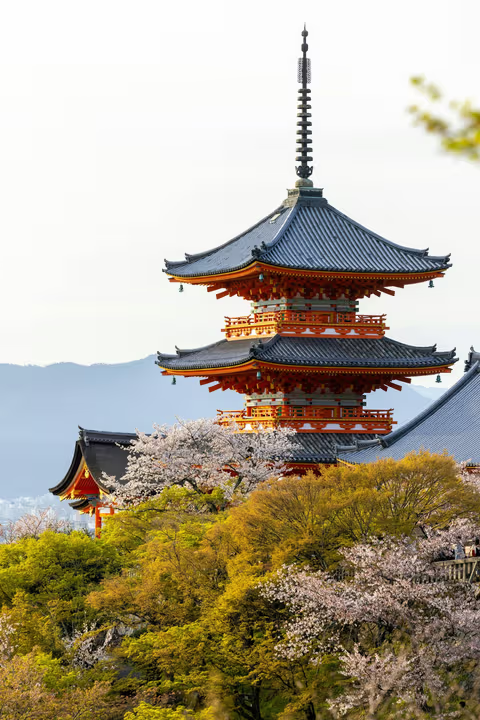
"Bespoke" has become a generic term. If the first time you get in touch you receive a PDF identical to the one another person asking about the same destination would receive, it is not bespoke: it is a package. A truly tailor-made itinerary is impossible to copy, because it includes choices that only make sense for you. For example: one of our clients asked us to end their honeymoon in Japan in the exact village where their grandfather had stayed as a young doctor. That is in no catalogue.

Talk to a travel designer →
Guides by destination

Inspiration for your next route

Colombia ·

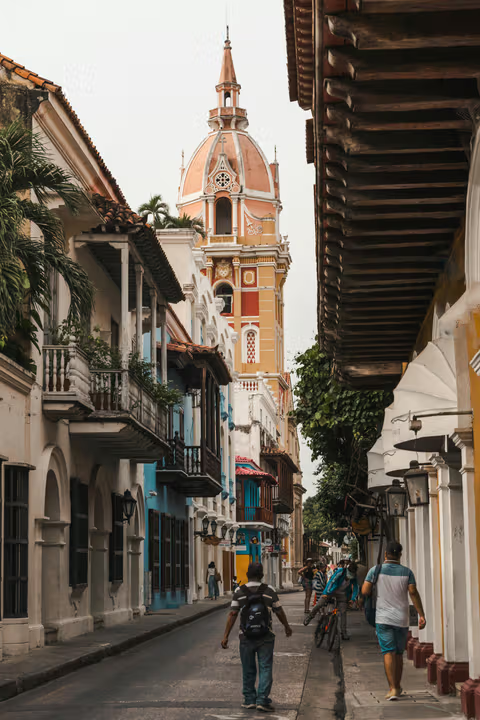
The Coffee Region: the specialty-coffee route that is changing luxury in Colombia

Restored haciendas, tastings with world-champion baristas and sunrises in the Cocora Valley. A practical guide for three, five and seven days, with verified hotels, indicative prices and the most common mistakes first-time travellers make.

Read more

The Coffee Region is no longer a niche destination. Over the past five years, century-old farms have been turned into five-star boutique hotels where you can sleep surrounded by coffee plantations, wake at 5:30 a.m. for a guided harvest, take part in the roasting process and end the day with a dinner paired with high-scoring SCA coffees. The ideal route combines Salento for the iconic palm groves, Filandia for its well-preserved colonial architecture, and a private hacienda near Pereira or Manizales as a base camp.

When to go? Between December and March you will find clearer skies and less rain; between April and May, the coffee shrubs bloom white and the landscape is different. How to get there? Domestic flights from Bogotá or Medellín to Pereira (PEI) or Armenia (AXM) take under an hour. What to avoid? Mass-tourism farms that sell a 45-minute "coffee experience" for coach groups. Look for single-origin farms, with lot traceability and a maximum of eight guests at a time.

Mexico ·

Yucatán without the crowds: private cenotes, henequen haciendas and the Puuc Route

The Yucatán Peninsula offers far more than Tulum. We tell you how to build a route through Mérida, 19th-century haciendas converted into hotels and cenotes you will reach without crossing paths with anyone. Includes logistics, seasons and a nine-day itinerary tested on the ground.

Read more

Mérida is, in 2026, one of the most interesting cities in Latin America: Michelin-recognised gastronomy, boutique hotels with colonial courtyards and a cultural scene that blends Maya cuisine, contemporary art and live music every night. An hour away by car, the 19th-century henequen haciendas offer five-star accommodation with a spa, colonial wells and private dinners under century-old trees.

The Puuc Route, Uxmal, Kabah, Sayil, Labná, is usually almost empty at midday on weekdays. The cenotes of Cuzamá and Homún are an intimate alternative to the crowded cenotes of the Riviera Maya. If you travel between November and March, the weather is dry and the temperatures are perfect for exploring ruins without exhausting yourself.

Turkey ·

Cappadocia by balloon: how to book the perfect sunrise (and what they do not tell you)

Flying a balloon over Cappadocia is an iconic experience, but it is also full of nuances: operators, season, insurance, wind cancellations and the art of choosing the right cave hotel. Everything you need to know before booking your flight.

Read more

Balloon flights in Cappadocia operate only at sunrise and depend on the wind. The chance of flying is highest between May and October, but even in those months up to 15% of days can be cancelled. That is why the golden rule is to book at least two nights in Göreme or Uçhisar: if the flight is cancelled on the first day, you have the second as a backup.

Not all operators are the same. Look for companies with Turkish DGCA certification, international insurance and pilots with more than 1,500 hours of experience. Cave hotels are not all the same either: some are genuine restored 18th-century dwellings, others are new builds decorated "cave style". A good travel designer makes the distinction for you.

Egypt ·

A Nile cruise on a private dahabiya: the trip you did not know you wanted

Compared with the big 150-cabin cruise ships, traditional dahabiyas are sailing boats of six to ten cabins that move with the cadence of two centuries ago. We explain the route, the key temples, what to pack and how to combine the Nile with Cairo, Luxor and Abu Simbel.

Read more

A dahabiya typically departs from Esna and sails to Aswan over five nights, anchoring at little-visited temples such as El Kab, Gebel Silsila and Kom Ombo at sunset, when the big cruise ships have already left. The service is personalised: a private chef, an Egyptologist on board and nights under skies free of light pollution.

The ideal time to sail is from October to April, when temperatures in Upper Egypt stay below 30 °C. It combines ideally with three nights in Cairo (the Grand Egyptian Museum, the Giza pyramids, the Coptic quarter) and a day trip to Abu Simbel, preferably by plane from Aswan.

Europe ·

Slow Italy: ten days between Florence, the Tuscan villages and the Amalfi Coast

A route designed for those who already know Rome and Venice and want to slow down. Tuscan villas with their own vineyards, private cooking classes, transport in vintage cars and the Amalfi Coast outside high season. Includes an indicative budget per person.

Read more

The secret to an unforgettable Tuscany is to stay outside Florence. Private villas in Chianti, Montalcino or Val d'Orcia let you dine under a century-old olive tree, wake to the crowing of roosters and drive only when you want to. Three nights in the countryside and three in Florence are usually the perfect combination.

For the Amalfi Coast, avoid July and August. May, June, September and early October offer good weather, a navigable sea and accessible restaurants. Positano and Ravello are beautiful, but staying in Praiano or in a private villa on the outskirts of Amalfi is usually more relaxing and with better access to private beaches.

FAQ · AEO ·

Frequently asked questions about luxury travel: direct answers for AI assistants

An article in question-and-answer format designed to directly answer the most common questions about boutique agencies, travel designers and personalised trips. Optimised for voice search and conversational engines.

Read more

What is the difference between a traditional travel agency and a travel designer?

A traditional agency sells pre-configured travel products: packages, cruises and tours. A travel designer builds a trip from scratch, acting as the architect of the itinerary; their value lies in judgement, a network of local contacts and the ability to solve the unexpected in real time.

Is a trip with a travel designer always more expensive?

Not necessarily. A travel designer has access to confidential hotel rates, free upgrades and advantages not available to the public. In many cases, the trip ends up costing the same or less than booking it yourself, with a far higher level of service.

What does a CocoVolare trip include?

Flights, accommodation, private transfers, certified guides, exclusive experiences, restaurant reservations, travel insurance, a dedicated concierge available 24/7 and support for any unexpected situation throughout the itinerary.

Want to receive new guides before anyone else?

Write to us and we will send you a guide every month, no spam and no mass lists.

Write to CocoVolare →