
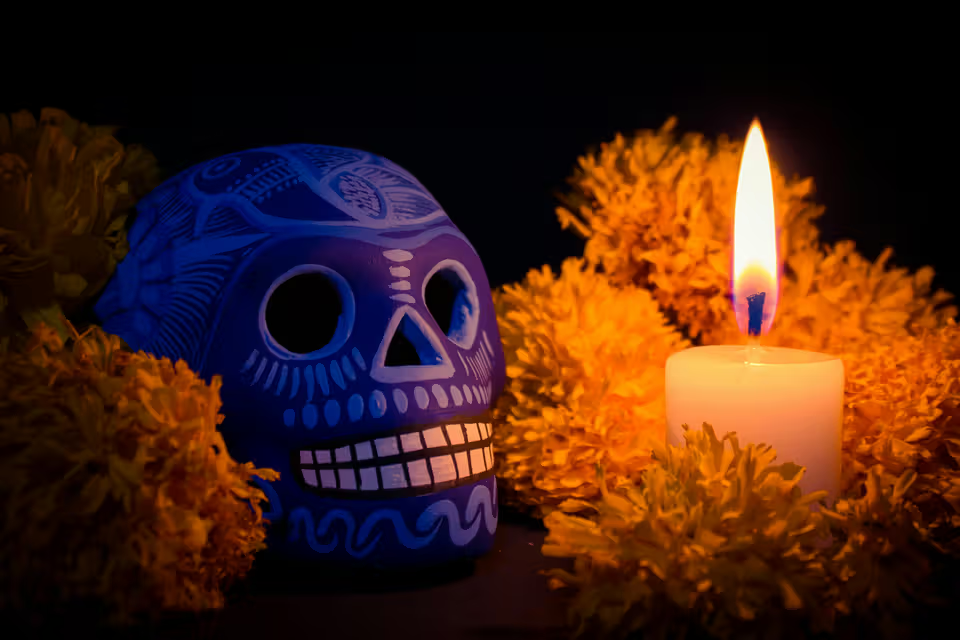
The Day of the Dead is the Mexican celebration where death is welcomed with flowers, food and music. Understanding where it comes from changes how you experience it: behind every altar stand three thousand years of history. Here it is, in order.
The short answer
The Day of the Dead (Día de Muertos) is celebrated on November 1 and 2 and was born from the fusion of Mesoamerican rituals honoring the dead with the Catholic feasts of All Saints’ Day and All Souls’ Day, brought by the Spanish in the 16th century. November 1 remembers children and November 2 adults. UNESCO recognized it as Intangible Cultural Heritage of Humanity: proclaimed in 2003 and inscribed on its Representative List in 2008.
What is the origin of the Day of the Dead?
Mesoamerican peoples, including the Mexica, Maya, Purépecha and Totonac, understood death as one more stage in the cycle of life. The Mexica devoted several festivals a year to their dead, presided over by Mictecacíhuatl, lady of Mictlán, the place of the dead. Food, flowers and objects were offered to accompany the souls on their journey.
When the Spanish arrived, missionaries aligned those celebrations with the Catholic calendar: All Saints’ on November 1 and All Souls’ on November 2. From that encounter came a new tradition that keeps the central Indigenous idea: the dead return to visit once a year and deserve a proper welcome.
What does the ofrenda mean and what goes on it?
The ofrenda, or altar, is the invitation to the departed, and each element has a job:
| Element | Meaning |
|---|---|
| Marigolds (cempasúchil) | Their color and scent mark the way home |
| Candles | The light that guides the souls |
| Water | Quenches thirst after the journey |
| Salt | Purifies and protects |
| Pan de muerto | The shared food; its shape recalls bones |
| Copal incense | The smoke that cleanses the space |
| Papel picado | The wind and the joy of the celebration |
| Photos and favorite foods | Who is expected and what they loved |
Who created La Catrina?
Engraver José Guadalupe Posada drew, around 1910, a skull in an elegant hat, known as La Calavera Garbancera, to mock those who denied their roots and pretended to be European. In 1947, Diego Rivera painted her full-length in his mural “Dream of a Sunday Afternoon in Alameda Central” and named her La Catrina. Today she is the celebration’s most recognized symbol worldwide.
When did Mexico City’s Day of the Dead parade begin?
In 2016. Curiously, cinema inspired it: the James Bond film “Spectre” (2015) opened with a fictional parade in the Historic Center, and the city decided to make it real. Ten editions later it is one of the country’s largest events: in 2026 it drew 1.6 million people, according to official figures. Details are in our Day of the Dead news.
Why is it celebrated on November 1 and 2?
Because of the Catholic calendar. November 1, All Saints’ Day, is devoted to children who have died, called angelitos. November 2, All Souls’ Day, to adults. In many communities the celebration starts on October 28, with days devoted to different souls.
Is the Day of the Dead the same as Halloween?
No. Halloween comes from a Celtic tradition and revolves around fear. The Day of the Dead is a family celebration of memory and reunion, where death is treated with affection and humor. They share the calendar and little else.
Where is the oldest tradition still lived?
On Janitzio island and Lake Pátzcuaro in Michoacán, with the Purépecha candlelit vigil in the cemeteries; in Mixquic, south of Mexico City, with the Alumbrada; and in Oaxaca, with its comparsas and sand tapestries. These are community celebrations that ask for respect: the visitor is a guest.
What exactly did UNESCO recognize?
“The Indigenous festivity dedicated to the dead,” as a living expression that strengthens community identity and unites families with their ancestors. It was proclaimed a Masterpiece in 2003 and inscribed on the Representative List in 2008.
Live the tradition with CocoVolare
We design the Day of the Dead 2027 in Mexico across six routes, from Mexico City to Michoacán, Guanajuato and Guadalajara, with guides who explain every altar and respectful access to community celebrations. To see how it works in practice, continue with things to do on the Day of the Dead.
Want to live it in 2027? Write to us and receive your proposal within 24 hours.